Custom Web Development vs. WordPress: A Guide for Business Owners
WordPress is the web's most widely used CMS. But that doesn't mean it's right for your business. Here's how to make the right technical decision for your business website.
Graphxify Team
4 min read
The Question Every Business Owner Asks
When building or rebuilding a business website, almost every business owner eventually asks: "Should we use WordPress, or do we need something custom?" It's the right question — and the answer has real implications for your budget, timeline, performance, and how you'll manage the site for the next five years.
This guide gives you a clear-eyed comparison to help you make the right decision for your specific situation.
What WordPress Actually Is
WordPress started as a blogging platform in 2003. Over the past two decades, it has evolved into the world's most widely used content management system. Its appeal comes from:
- A massive library of plugins and themes
- A large pool of developers who know it
- Relatively lower upfront development costs
- A familiar content editing interface
This sounds compelling — and for many use cases, it is. But WordPress also carries significant tradeoffs that are frequently undersold.
The Case for WordPress
WordPress is a strong choice when:
- Your development budget is limited and you need to launch quickly
- Your website is primarily informational (pages, blog, contact form)
- You or your team will be managing content regularly and need a familiar interface
- You need a large library of third-party integrations (e-commerce via WooCommerce, booking systems, CRM plugins)
- You anticipate needing ongoing content additions from non-technical staff
For a service business that needs a 5–10 page marketing site with a blog, WordPress with a quality theme and careful plugin selection is often the right call.
The Case Against WordPress
WordPress can become a liability when:
Performance
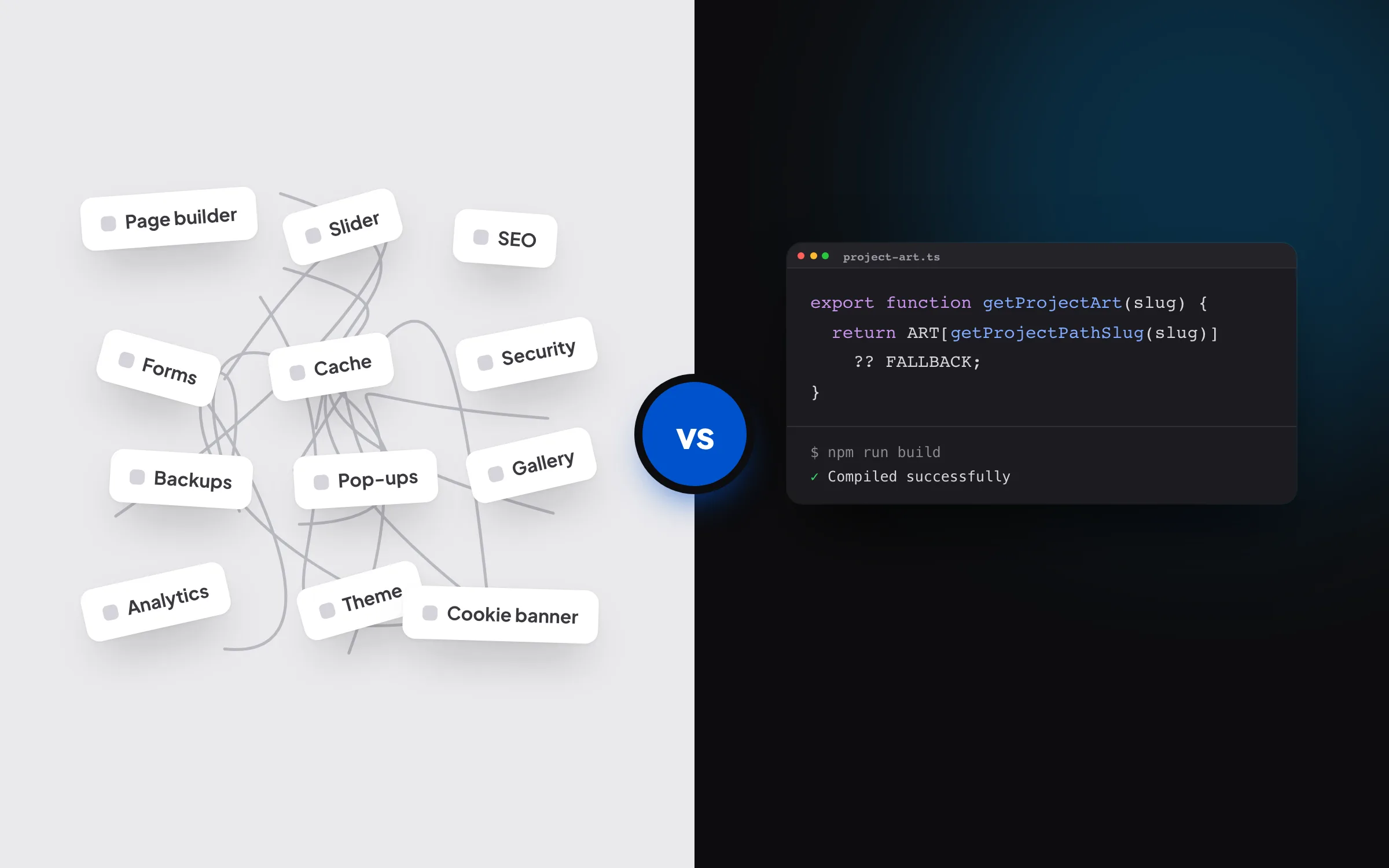
WordPress sites can easily become slow. With an average theme, several plugins, and unoptimized images, slow server response times (Time to First Byte, or TTFB) are common. Google's web.dev guidance says most sites should aim for a TTFB of 0.8 seconds or less. Achieving competitive Core Web Vitals scores on WordPress often requires significant optimization work — caching layers, CDN configuration, image optimization, database query tuning — that adds cost and complexity.
Security
WordPress is one of the most frequently targeted platforms on the web — not because it's uniquely insecure, but because it's so widely used. Sites running outdated plugins or themes are a common target. Keeping a WordPress site secure takes ongoing attention: plugin updates (sometimes breaking), security scanning, and regular maintenance.
Scalability and Custom Requirements
When your requirements go beyond standard pages and posts — custom application logic, complex user roles, third-party API integrations, performance-critical features — WordPress can work against you. Custom features often mean bending the platform to do something it wasn't designed for, producing technical debt that compounds over time.
Lock-in
Much of your content ends up structured around WordPress's own database schema, themes and plugins (shortcodes, page-builder markup), which can make migrating away later time-consuming and costly.
When Custom Web Development Makes Sense
Custom development — building on modern frameworks like Next.js, with a proper headless CMS — is often the better choice when:
- Performance is non-negotiable (e-commerce, lead generation, SaaS marketing sites)
- You have complex custom functionality requirements
- You need precise control over the user experience
- Your business is scaling and expects the site to handle significant traffic
- You want long-term maintainability without platform lock-in
A custom-built site using Next.js with a headless CMS (Sanity, Contentful, or a custom solution) can be engineered for high Lighthouse performance scores, has a smaller attack surface than a plugin-heavy install, and is built specifically for your business logic — not adapted from a generic template.
At a Glance
| WordPress | Custom Development | |
|---|---|---|
| Initial Build | Usually lower | Usually higher |
| Ongoing Maintenance | Regular core, theme and plugin updates | Dependency updates; fewer third-party plugins |
| Security | Larger attack surface when many plugins are used | Smaller attack surface; still needs maintenance |
| Performance | Achievable, but often needs optimization work | Can be engineered for performance from the start |
| Flexibility | Broad via plugins; limited for custom logic | Built around your specific requirements |
Our Recommendation
For most small businesses getting started: a well-built WordPress site is pragmatic. For businesses in growth mode, with performance and conversion as priorities, or with custom requirements: custom development is the stronger long-term investment.
The worst outcome is choosing WordPress to save money, then paying for a full rebuild in three years because the platform couldn't support where the business went.
Whatever platform you choose, performance on mobile is non-negotiable. See our guide on mobile-first website design for the specific metrics that matter for Google rankings and conversions.
Talk to a Web Development Agency
Graphxify builds custom websites using Next.js and modern headless CMS architecture — the same stack we use for our own platform. See examples of our work or get in touch to discuss your project.